Generative AI
13 Minute
Remove Unwanted Objects from Video Using KlingO1
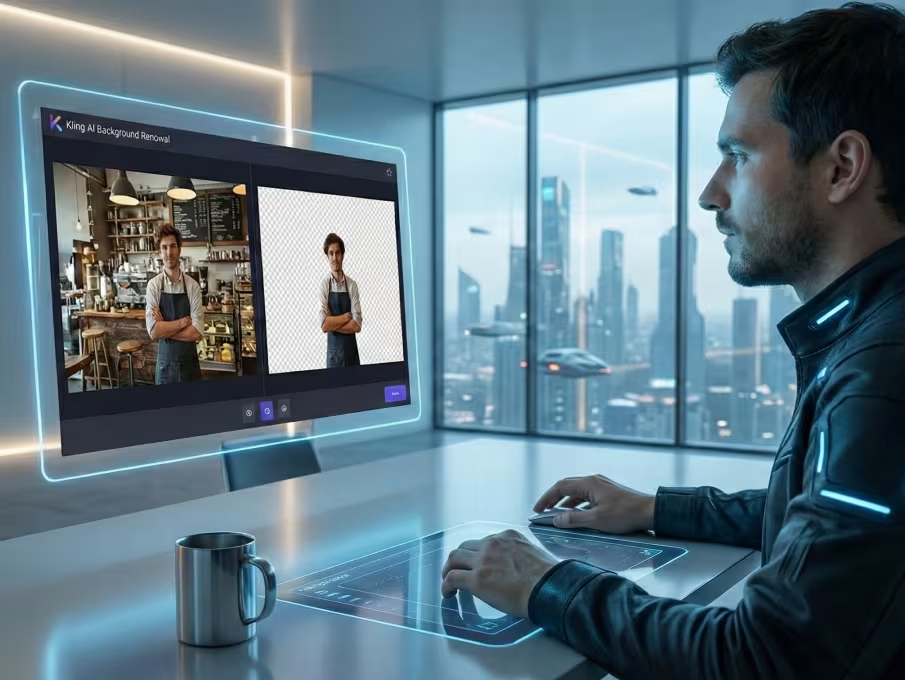
In the fast-paced world of AI video, “fix it in post” has evolved from an expensive last resort to a seamless, one-click reality. As a team of AI video experts who have navigated high-pressure production workflows at Storia, we have spent the last year stress-testing every tool on the market, from Runway’s Gen-3 to Adobe Firefly -searching for the “Holy Grail” to remove unwanted objects from video.
We finally found it in Kling O1.
After months of rigorous testing, we can confidently say this isn’t just an incremental update. It is a fundamental shift in how professionals handle messy, real-world footage. Here is our deep dive into why Kling O1 has become the centerpiece of our 2026 editing toolkit.
Why Kling O1 Is Our New Industry Standard
While many creators focus on generating new elements, the real professional value lies in subtraction. Kling O1’s strength is rooted in its Smart Clean Up feature, which doesn’t just apply a blur – it reconstructs the background frame-by-frame.
Through our trials, we found it excels at preserving:
- Parallax: Backgrounds shift correctly in relation to camera movement.
- Global Illumination: The AI recalculates how light interacts with the newly “empty” space.
- Reflections: It can often infer what a window or puddle should look like once a distracting bystander is removed.
The conversational prompts are magic: We experimented by typing “Remove all people from the background” and it rebuilt backgrounds spot-on; Multi-Elements mode adds a precise delete brush and outpainting for consistency across text, image, or video inputs – vital for my storytelling ads.
Key Features: Beyond the Brush
- What sets Kling apart from the “ghosting” masks we’ve seen in the past?
- Contextual Inpainting: It infers geometry and texture. If we remove a lamp, the model understands whether a brick wall or a wooden fence belongs behind it based on the surrounding environment.
- Conversational Prompting: We aren’t limited to manual brushing. We’ve seen incredible success using natural language like: “Remove all people from the background but keep the stadium lights.”
- Multi-Element Consistency: Unlike earlier models that suffered from “flickering,” Kling O1 maintains temporal stability for clips up to 10 seconds.
Our Proven Workflow to Remove Unwanted Objects from Video
To cut editing time by 70%, we recommend moving away from “point and click” and following this structured workflow:
- High-Res Upload: Always use the highest bitrate available. The AI needs data to “see” what it is replacing.
- Scene Segmentation: For complex shots, we don’t try to remove ten objects at once. We remove the largest distractions first, then perform a second pass for smaller items.
- Precise Prompting: Instead of a generic “delete,” we use prompts like “Remove [object] and extend the horizon line.”
- Post-Removal Relighting: We suggest using the “align shadows naturally” command if the removed object left a “ghost” shadow behind.
Real Talk: The Current Limitations
No tool is perfect. In our collaborative sessions with other editors, we’ve noted a few areas where care is needed:
- Extreme Lighting: High-contrast scenes can still cause minor “smearing.”
- Proximity Issues: If an object is removed very close to a person’s face, the AI sometimes struggles to maintain the skin texture of the primary subject.
- The 10-Second Window: For long-form content, you will need to stitch segments together, which requires careful color matching.
Final Verdict
For years, manual rotoscoping and clone-stamping were the grueling tasks that kept editors in the studio until dawn. Kling O1 transforms that VFX nightmare into a simple line item in a workflow.
We believe that if you are tired of shooting “around” reality and want the power to curate your environment after the cameras stop rolling, this is the tool to use. It allows editors to focus on what matters: story, timing, and emotion.
What is the first thing your team will erase from your footage? Let’s discuss in the comments – we are curious to see how you are pushing the limits of this technology.
At Storia Films, an AI video production company with services in London, Switzerland, Belgium, and India, we’re harnessing tools like Kling O1 to redefine your post-production workflow.